Case Study

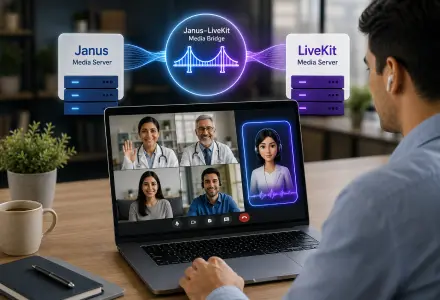


Many organizations that adopted WebRTC over the last decade built reliable conferencing platforms around mature media servers such as Janus, Jitsi, Kurento, or FreeSWITCH. Today, these
organizations want to introduce Agentic AI capabilities—AI meeting assistants, digital avatars, voice agents, real-time translation, meeting summaries, and conversational AI. The
common recommendation is often to migrate to a newer media server ecosystem that offers built-in AI integration. However, such migrations are expensive, risky, and frequently unnecessary.

Case Study
Transform WebRTC Media Server & Application into Agentic AI Platform
Set up a Meeting

Many organizations that adopted WebRTC over the last decade built reliable conferencing platforms around mature media servers such as Janus, Jitsi, Kurento, or FreeSWITCH. Today, these
organizations want to introduce Agentic AI capabilities—AI meeting assistants, digital avatars, voice agents, real-time translation, meeting summaries, and conversational AI. The
common recommendation is often to migrate to a newer media server ecosystem that offers built-in AI integration. However, such migrations are expensive, risky, and frequently unnecessary.
SpringCT recently helped a customer preserve their existing investment by integrating Agentic AI into a production conferencing platform built on Janus Media
Server—without replacing the core media infrastructure. Instead, SpringCT designed and implemented an intelligent media bridge between Janus and LiveKit, allowing both platforms
to coexist seamlessly. The result was a significantly lower implementation cost, minimal business disruption, and a future-ready architecture capable of supporting AI-driven
experiences.
Customer Challenge:
The customer had already invested several years in building a conferencing platform around Janus Media Server. The platform included:
- Multi-party conferencing
- Screen sharing
- Recording
- SIP interoperability
- User authentication
- Meeting management
- Custom moderation features
- Mobile and web applications
- Operational monitoring and deployment automation
As the customer planned to introduce an AI-powered avatar service, they discovered that the third-party AI platform was tightly integrated with LiveKit for real-time media processing. The
straightforward approach appeared to be replacing Janus entirely with LiveKit. However, this raised several concerns:
- Rebuilding years of WebRTC development
- Rewriting media workflows
- Revalidating production stability
- Migrating thousands of lines of client code
- Re-testing every conferencing feature
- Increased deployment and operational risk
- Extended project timelines
The migration effort threatened to outweigh the actual AI implementation.
SpringCT's Evaluation:
Rather than recommending a complete migration, SpringCT performed a detailed assessment of the existing platform. The evaluation focused on:
- Existing media architecture
- WebRTC signaling flows
- Publisher/subscriber management
- Recording workflows
- SIP integration
- Conference control APIs
- Client SDK dependencies
- Scalability requirements
- AI integration requirements
- Latency expectations
The assessment revealed that over 90% of the conferencing platform remained fully capable of supporting future business needs. The only missing capability was seamless interoperability
with AI services that expected LiveKit rooms. This insight changed the entire implementation strategy.
Features That Would Have Been Impacted by a Full Media Server Migration:
Replacing the media server would have required extensive redevelopment across multiple layers.
- Media Layer: Publisher management, subscriber handling, simulcast configuration, bandwidth adaptation, recording pipeline
- Client Applications: Web SDK changes, mobile SDK changes, room lifecycle, device management, ICE and signaling changes
- Server Components: Conference orchestration, user presence, media event handling, monitoring, analytics
- Operational Components: Deployment automation, scaling policies, production monitoring, existing troubleshooting tools
Each of these changes would require development, QA, production rollout, and user validation.
SpringCT's Solution:
Instead of replacing Janus, SpringCT introduced a Janus–LiveKit Media Bridge. The bridge allowed both media servers to operate together while serving different responsibilities. The
bridge continuously monitored activity within Janus conference rooms.
From the application's perspective, nothing changed. Human participants remained connected through Janus. AI participants appeared as regular conference users.
Janus-LiveKit Media Bridge architecture
Product Features
Stream Detection
Detecting newly published audio/video streams.
Publisher Subscription
Subscribing to Janus publishers.
Media Forwarding
Forwarding media streams into corresponding LiveKit rooms.
Participant Lifecycle Synchronization
Synchronizing participant lifecycle events.
Low-Latency Media Transport
Maintaining low-latency media transport.
AI Media Reception
Receiving AI-generated media from LiveKit.
AI Media Republishing
Republishing AI audio/video back into Janus conferences.
Stream Cleanup
Managing stream cleanup when participants left.
Key Technical Outcomes
Janus-to-LiveKit real-time media interoperability
LiveKit-to-Janus AI media publishing
Transparent participant synchronization
Low-latency media forwarding
Support for third-party avatar services
Minimal changes to the existing application
Future-ready architecture for additional Agentic AI capabilities
Business Benefits
The bridge-based architecture delivered several important advantages.
- Preserved Existing Investment: The customer retained years of engineering investment without rewriting the conferencing platform.
- Faster AI Adoption: Agentic AI capabilities were introduced without waiting for a large-scale platform migration.
- Lower Project Risk: Critical conferencing features remained untouched, reducing regression risk.
- Incremental Modernization: LiveKit could be introduced gradually where required rather than replacing the entire infrastructure.
- Production Stability: Existing customers experienced no disruption while AI features were added.
- Vendor Flexibility: The architecture remained open for future AI providers without locking the conferencing platform into a single media server.
Estimated Cost Savings
A complete migration from one production media server to another typically involves:
By introducing a targeted interoperability layer instead of replacing the media infrastructure, SpringCT enabled the customer to preserve their existing investment while accelerating AI adoption.
- Platform redesign
- Client SDK migration
- Feature redevelopment
- Extensive QA
- Production rollout
- User acceptance testing
- Operational retraining
By introducing a targeted interoperability layer instead of replacing the media infrastructure, SpringCT enabled the customer to preserve their existing investment while accelerating AI adoption.
Conclusion
- Modern AI capabilities should not require organizations to discard years of successful WebRTC engineering.
- In many cases, the existing conferencing platform remains highly capable, requiring only a carefully designed interoperability layer to connect with emerging AI ecosystems.
- By developing a real-time bridge between Janus Media Server and LiveKit, SpringCT enabled the customer to integrate Agentic AI, digital avatars, and real-time conversational experiences while preserving their existing conferencing platform.
- The project demonstrates that modernization does not always require replacement. Sometimes, the most effective path forward is building the right bridge between proven technology and the next generation of AI.
