Case Study



Case Study
IoT and Agentic AI for Energy Management
Set up a Meeting
Modern commercial facilities face constant pressure to reduce
energy consumption while maintaining comfort, safety, and
productivity. Lighting alone can account for a significant share
of a building’s operational energy costs, especially in large
offices, campuses, and retail complexes. Traditional automation
systems rely on static schedules or simple motion sensors, which
often fail to adapt to real-world usage patterns.
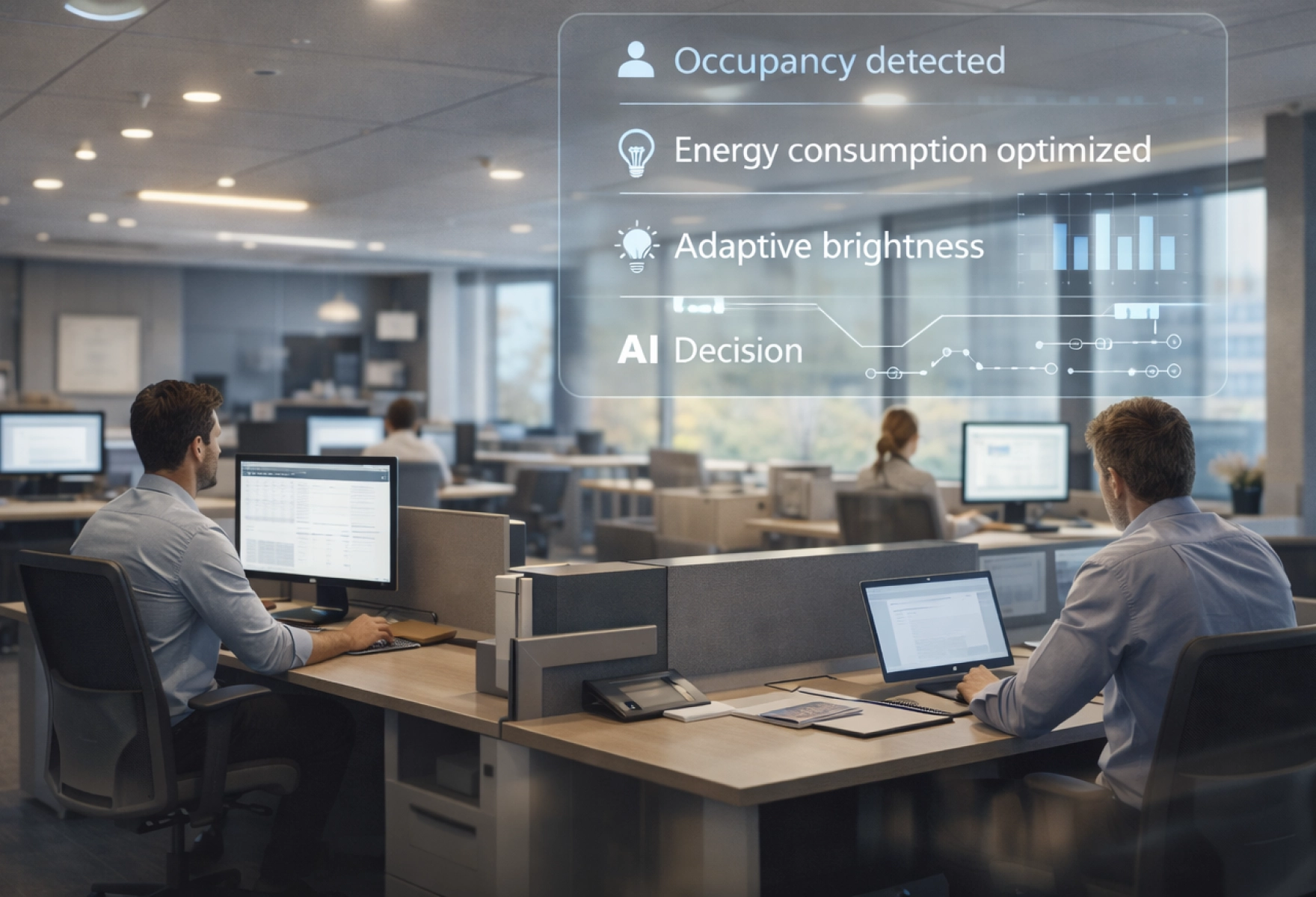
SpringCT developed an intelligent, self-managing lighting control system in a commercial facility using a combination of Internet of Things (IoT) infrastructure and agentic artificial intelligence (Agentic AI), which helped transform lighting from a reactive utility into a proactive, adaptive service.
SpringCT developed an intelligent, self-managing lighting control system in a commercial facility using a combination of Internet of Things (IoT) infrastructure and agentic artificial intelligence (Agentic AI), which helped transform lighting from a reactive utility into a proactive, adaptive service.
Product Features
- SpringCT designed the lighting automation solution around flexibility, autonomy, and user comfort. At its core, the system continuously adjusted lighting levels based on occupancy, daylight availability, time of day, and operational context. Facility managers can define high-level goals such as minimizing energy use, meeting sustainability targets, or prioritizing employee comfort without manually configuring every space.
- Key features include zone-based lighting control, real-time occupancy awareness, daylight harvesting, and predictive scheduling. The system also supports overrides through a mobile or web interface, allowing occupants or managers to temporarily adjust lighting when needed. Importantly, the agentic AI learns usage patterns over time, enabling it to anticipate lighting needs for meetings, cleaning schedules, or peak working hours without explicit instructions.
Key Technical Achievements
- Implementing such a system presented several technical challenges. One major issue was data variability. IoT sensors produced large volumes of real-time data with varying levels of accuracy and reliability. Occupancy sensors could misinterpret movement, while daylight sensors were affected by weather and window orientation.
- Another challenge was interoperability. The facility already had a mix of legacy lighting controllers and newer smart fixtures from different vendors. Integrating these into a unified control plane required careful abstraction and protocol translation. Latency and reliability were also critical; lighting decisions needed to be made quickly and consistently to avoid flicker, delays, or user frustration.
- Finally, deploying agentic AI in a physical environment raised safety and trust concerns. The system had to ensure that autonomous decisions never compromised safety standards, such as emergency lighting requirements or minimum illumination levels.
Technologies Used
- The solution combined a layered IoT architecture with an agentic AI decision layer. At the edge, IoT devices such as motion sensors, ambient light sensors, smart switches, and connected luminaires communicated using protocols like Zigbee, BACnet, and MQTT. Edge gateways aggregated sensor data and performed initial filtering to reduce noise and bandwidth usage.
- Above this layer, a cloud-based platform handled data storage, analytics, and integration with building management systems. The agentic AI component consisted of multiple specialized agents, each responsible for a specific objective—energy optimization, comfort management, or compliance. These agents observed the environment, reasoned about trade-offs, and coordinated actions using shared context and policies.
- Machine learning models supported the agents by forecasting occupancy trends and daylight availability, while rule-based constraints ensured regulatory compliance. The agentic approach allowed the system to adapt dynamically, rather than following rigid automation scripts.
Results
- After deployment, the facility experienced measurable improvements within the first few months. Energy consumption related to lighting dropped significantly, largely due to reduced after-hours usage and better daylight utilization. Occupant feedback indicated improved comfort, with fewer complaints about overly bright or dim spaces.
- Facility managers reported reduced operational overhead, as the system required minimal manual tuning once it learned normal building behavior. The AI agents also identified inefficiencies, such as lights frequently activated in rarely used areas, prompting layout or policy adjustments. Overall, the system demonstrated resilience, continuing to operate effectively even when individual sensors failed.
Conclusion
The combination of IoT and agentic AI enabled a new
generation of intelligent lighting control that goes beyond
traditional automation. By sensing, learning, and acting
autonomously within defined goals, the system aligned energy
efficiency with human comfort and operational reliability.
SpringCT used the combination of agentic AI to unlock the
full potential of IoT in commercial facilities, creating
smarter, more sustainable buildings that continuously adapt
to how people actually use them.
